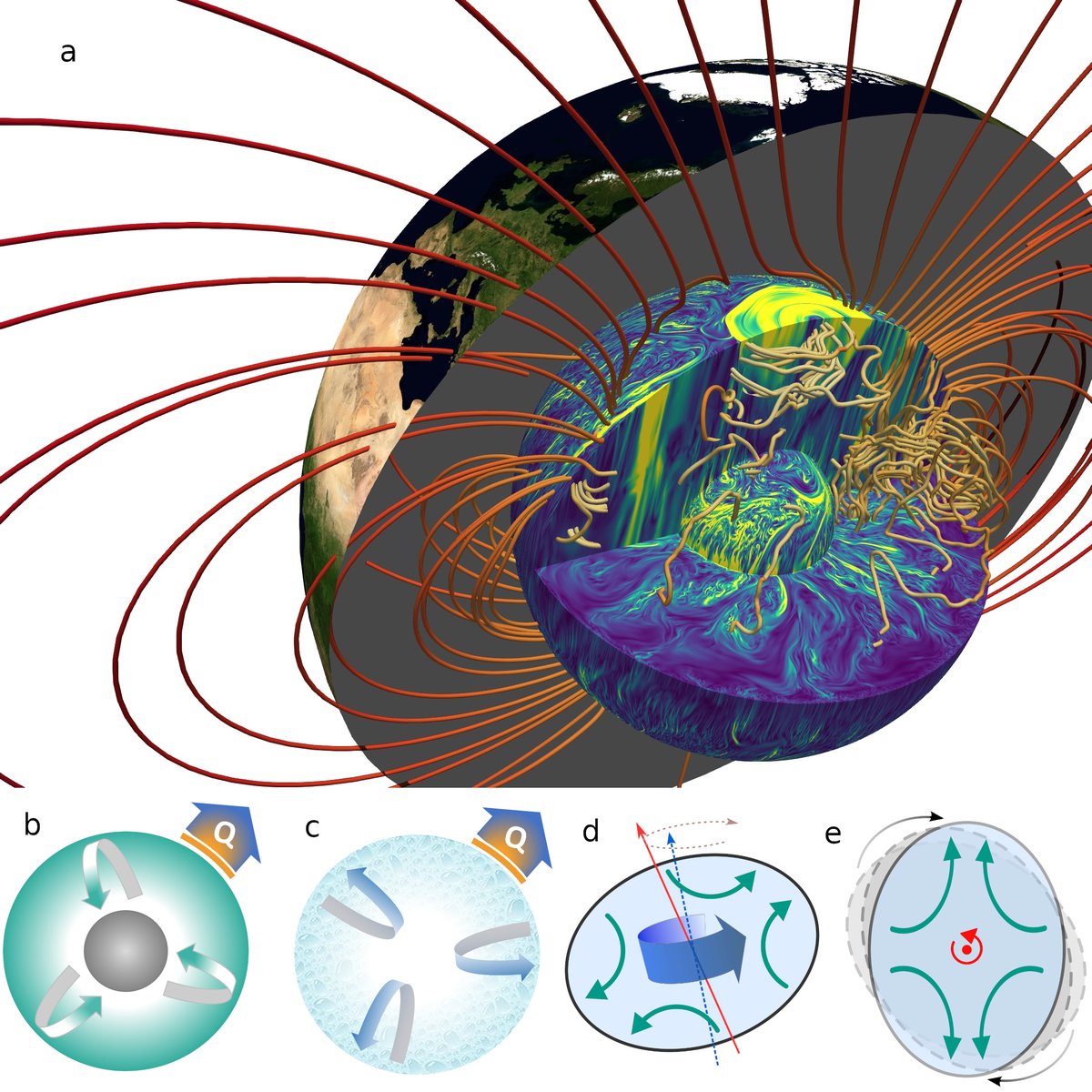
Imagine Earth without its magnetic field. It's a stark thought: a planet stripped bare, exposed to the sun's fury, its atmosphere slowly eroding into space. This isn't science fiction; it's a very real possibility if not for one of the most remarkable and dynamic processes happening deep within our planet: the geodynamo. Understanding the Geodynamo Theory isn't just an academic exercise; it's the key to comprehending why Earth is a habitable haven, shielding us from cosmic threats and guiding life in countless ways.
At its core, this theory explains how our planet generates and maintains its powerful, life-sustaining magnetic field. It’s a story of molten metal, swirling currents, and the relentless spin of our home world, all working in concert to create an invisible shield that touches every aspect of our existence.
At a Glance: Your Earth's Shield, Demystified
- What is it? The Geodynamo Theory explains how Earth's magnetic field is generated.
- Where? Deep within our planet's outer core, a liquid layer of iron and nickel.
- How? Heat drives molten metal in swirling currents. Earth's rotation (Coriolis effect) organizes these currents.
- The result? A self-sustaining process that amplifies and maintains a global magnetic field.
- Why it matters: Protects us from harmful solar radiation, guides navigation, and is crucial for planetary habitability.
- It's dynamic: The field constantly changes, even reversing poles over geological timescales.
The Invisible Force Protecting Our World
Before we dive into the "how," let's appreciate the "what" and "why." Earth's magnetic field is an omnipresent, yet largely unseen, force that wraps around our planet. You can't see it, touch it, or usually even feel it, but its influence is profound. This field extends thousands of kilometers into space, creating a protective bubble known as the magnetosphere.
This magnetosphere acts as our planetary bodyguard. It deflects the constant barrage of solar wind – a stream of charged particles ejected by the sun – and largely shields us from harmful cosmic radiation. Without it, these energetic particles would erode our atmosphere, scorch our surface, and render life as we know it impossible. Mars, for example, lost most of its magnetic field billions of years ago, and with it, much of its atmosphere. The difference is stark.
Beyond protection, our magnetic field is also a fundamental navigation tool. From migrating birds and sea turtles that use it to find their way across vast distances, to the compasses that historically guided human explorers, its influence on direction and orientation has shaped both natural history and human civilization. So, when we talk about the geodynamo, we're discussing the very foundation of our planet's suitability for life.
Decoding the Earth's Inner Engine: The Geodynamo Theory Explained
So, how does our planet pull off this incredible feat? The Geodynamo Theory posits that Earth's magnetic field isn't a permanent magnet, but rather a self-sustaining dynamo – much like an electrical generator – operating within its deep interior. This process hinges on the dynamic interaction of molten, electrically conductive materials.
At its core, the theory states that the movement of electrically conductive molten iron and nickel in Earth's outer core generates its magnetic field. This isn't just any movement; it's a specific, organized kind of motion driven by immense energy. The critical action unfolds approximately 2,900 kilometers (1,800 miles) beneath your feet, in the magnetic field generation layer itself: the outer core.
For this grand-scale geological generator to work, three essential ingredients must be present and interact:
- A Conducting Fluid: The outer core is primarily liquid iron, mixed with about 10% nickel and lighter elements like sulfur, oxygen, or silicon. Iron, as you might recall from your basic physics, is an excellent electrical conductor, especially when molten. This fluid acts as the "wire" in our planetary dynamo.
- Convection: This isn't just a static pool of molten metal. Heat escaping from the solid inner core and residual primordial heat from Earth's formation create immense thermal and compositional buoyancy-driven motions. Think of it like a giant pot of boiling water, but on a planetary scale and with incredible pressures. Hotter, lighter material rises, while cooler, denser material sinks, creating powerful convection currents. This provides the kinetic energy needed to move the conducting fluid.
- Rotation (The Coriolis Effect): Here's where Earth's spin becomes crucial. Our planet rotates on its axis, and this rotation imparts a spiraling, helical motion to the convective flows in the outer core. This phenomenon, known as the Coriolis effect (the same force that influences weather patterns and ocean currents), structures these otherwise chaotic movements into organized patterns, often described as complex columnar vortices. Without this rotational influence, the convection would be less organized, and a stable, coherent magnetic field couldn't form.
These three components – a conducting fluid, convection currents, and planetary rotation – are the fundamental pillars of the geodynamo. They set the stage for a continuous, self-amplifying cycle that has sustained Earth's magnetic field for billions of years.
How the Dynamo Sustains Itself: The Alpha-Omega Cycle
The geodynamo isn't a one-and-done event; it's a self-sustaining feedback loop. Existing weak magnetic fields interact with the moving conductive fluid to generate electric currents, which in turn generate new magnetic fields. This continuous regeneration and amplification are often simplified into two primary effects, known as the Alpha-Omega cycle:
- The Omega Effect: Imagine existing magnetic field lines (like those from a weak, initial field). As the outer core fluid differentially rotates – meaning different parts spin at different speeds, much like a washing machine agitator – these field lines are stretched and sheared. A poloidal field (imagine lines running from north to south, like a bar magnet) gets stretched and wrapped around the core, converting it into a much stronger toroidal field (lines encircling the core from east to west). This process effectively converts vertical magnetic energy into horizontal magnetic energy.
- The Alpha Effect: Now, those spiraling, helical convection currents (thanks to the Coriolis effect) come into play. As these swirling motions twist and rise through the toroidal field lines, they are capable of lifting and twisting these lines, effectively "tying them into knots." This complex twisting and rising motion regenerates a new poloidal field from the toroidal field. This is a critical step that closes the loop, continuously creating the north-south oriented field we detect at the surface.
This continuous dance between the Omega and Alpha effects ensures that the magnetic field is not only generated but also amplified and sustained over vast timescales.
What powers this incredible process? The primary energy source driving the convection isn't just residual heat. A significant contributor is the secular cooling of Earth and the solidification of the inner core. As the liquid outer core slowly cools and iron crystallizes to form the solid inner core, lighter elements are left behind in the outer core fluid. This process, called compositional convection, provides additional buoyancy, driving vigorous fluid motion. This is supplemented by residual primordial heat and, to a lesser extent, radiogenic heating from radioactive decay within the core and mantle.
Beyond Our Planet: Why the Geodynamo Matters Universally
The implications of the Geodynamo Theory extend far beyond just explaining Earth's magnetic shield. It provides a vital framework for understanding planetary evolution and the conditions necessary for life elsewhere in the cosmos.
- Planetary Habitability: The presence of a strong, dynamo-generated magnetic field is now considered a key factor in a planet's potential to support life. Without such a shield, a planet's atmosphere might be slowly stripped away by stellar winds, preventing the long-term stability of liquid water on its surface – a fundamental requirement for life as we know it. When astronomers search for exoplanets in the "Goldilocks zone" (the region around a star where temperatures might allow for liquid water), they're increasingly looking for signs of a magnetic field as well.
- Understanding Other Celestial Bodies: By studying Earth's geodynamo, scientists gain insights into the magnetic fields (or lack thereof) on other planets and moons in our solar system. Why does Jupiter have an incredibly strong magnetic field? Why does Mars have only localized remnants? The principles of the geodynamo help explain these differences, revealing clues about the internal structures, compositions, and thermal histories of these distant worlds.
The Geodynamo's Practical Impact: From GPS to Power Grids
While the geodynamo operates deep beneath our feet, its effects ripple through our daily lives in surprisingly direct ways.
- Navigation and Orientation: As mentioned, animals use the magnetic field for migration, and humans have historically relied on compasses. Today, while GPS has taken over much of human navigation, the magnetic field remains a fundamental reference point, especially for backups and in areas where satellite signals are weak.
- Space Weather Forecasting: Understanding the geodynamo and its variability is increasingly critical for modern technological societies. Solar flares and coronal mass ejections from the sun can send powerful bursts of charged particles toward Earth. Our magnetic field largely deflects these, but extreme events can cause "geomagnetic storms." These storms induce electrical currents in the ground, known as geomagnetically induced currents (GICs), which can disrupt power grids, damage transformers, interfere with satellite communications, and cause errors in GPS systems. By studying the geodynamo, researchers can better predict and mitigate the impacts of space weather, safeguarding our essential infrastructure. This directly contributes to technological sustainability in an increasingly interconnected world.
- Material Science and Computational Advancements: The quest to model and understand the geodynamo pushes the boundaries of several scientific fields. Simulating the complex magnetohydrodynamic (MHD) system within the Earth's core requires immense computational power and sophisticated algorithms. This drives advancements in high-performance computing and inspires new research in materials science to understand liquid metals under extreme pressures and temperatures.
The Dynamic Earth: Magnetic Field Reversals and Future Challenges
Earth's magnetic field isn't static; it's a dynamic entity that constantly changes in strength and direction. One of the most fascinating and sometimes unsettling aspects of the geodynamo is the phenomenon of magnetic field reversals. This is where the north and south magnetic poles switch places, essentially flipping the entire field.
Geological records show that these reversals have occurred many times throughout Earth's history, with varying frequencies. The last full reversal happened approximately 780,000 years ago, though there have been temporary excursions more recently. During a reversal, the field doesn't just instantly flip. It weakens significantly, becomes more complex with multiple poles, and then gradually re-establishes itself in the opposite direction. This process can take thousands of years.
While the exact causes of reversals are still debated among scientists – likely linked to chaotic dynamics within the outer core – their potential impacts are a significant area of research.
- Biological Impacts: The direct biological impacts of past reversals are still largely theoretical and debated. Many argue that life has endured countless reversals, suggesting robust adaptation. However, a prolonged period of a weakened field could expose organisms to higher levels of radiation, potentially affecting navigation for sensitive species or even increasing mutation rates.
- Technological Vulnerabilities: For modern society, the primary concern isn't about immediate biological catastrophe but about technological vulnerabilities. During a reversal, the weakened magnetosphere would offer less protection from solar and cosmic radiation. This could lead to:
- Increased frequency and intensity of power grid failures due to GICs.
- Widespread disruption of satellite communications and GPS, impacting everything from aviation to banking.
- Higher radiation doses for astronauts and even commercial airline crews.
Addressing these risks requires extensive interdisciplinary collaboration between geophysicists, space scientists, and engineers. Research aims to refine our understanding of reversal mechanisms, predict their onset, and develop strategies to mitigate associated risks, contributing to the long-term resilience and technological sustainability of human civilization.
Peeking Deeper: The Academic Edge of Geodynamo Research
For academics, the Geodynamo Theory is far from a settled topic. It represents one of the most challenging and complex problems in geophysics, delving into the realm of magnetohydrodynamics (MHD). This field of physics studies the dynamics of electrically conducting fluids.
At an academic level, the geodynamo is described by a set of coupled, nonlinear equations, including:
- Navier-Stokes equations: Describe fluid motion.
- Induction equation: Describes how magnetic fields are generated and interact with fluid motion.
- Heat equation: Describes how heat is transported through the fluid.
Solving these equations analytically is impossible due to their complexity. Instead, researchers rely on advanced numerical simulations, often requiring some of the world's most powerful supercomputers. These simulations create sophisticated 3D models of the Earth's core, allowing scientists to experiment with different parameters (e.g., core composition, heat flow, rotation rates) to see how they influence magnetic field generation and behavior.
This research, extending beyond pure geophysics, actively incorporates multicultural perspectives and cross-sectoral influences by: - Driving advancements in high-performance computing: The sheer computational demand of geodynamo models pushes the limits of supercomputer architecture and software development.
- Informing materials science: Understanding how liquid metals behave under the extreme conditions of Earth's core (immense pressure, high temperature) provides valuable data for materials scientists.
This continuous push for deeper understanding not only refines our knowledge of our own planet but also helps us piece together the grander cosmic puzzle of planetary formation and evolution.
Common Questions About Earth's Magnetism
Let's clarify some common points about Earth's magnetic field and the geodynamo.
- Is Magnetic North the same as Geographic North? No. Geographic North is the true north pole, fixed by Earth's axis of rotation. Magnetic North is where a compass needle points, and its location constantly drifts. Currently, Magnetic North is hundreds of kilometers from Geographic North and is moving at an accelerating pace. This drift is a direct manifestation of the dynamic processes within the geodynamo.
- Are magnetic field reversals dangerous? While a full reversal would undoubtedly pose significant challenges to our technology-dependent society, there's no evidence from past reversals in the geological record to suggest they caused mass extinctions or catastrophic biological events. The primary concern is about the prolonged period of a weakened field during a reversal, which would increase radiation exposure and disrupt infrastructure, not an immediate "flip" of disaster.
- Is Earth's magnetic field weakening? Yes, observations show that Earth's magnetic field has been weakening over the last few centuries, particularly in certain regions like the South Atlantic Anomaly. This weakening is part of the natural variability of the geodynamo and is actually consistent with patterns observed before past reversals. While it's a significant change, it doesn't necessarily mean a reversal is imminent, nor does it signal the field's permanent demise. It's simply another phase in its long, dynamic life.
Living with Our Planet's Dynamic Shield
Understanding the Geodynamo Theory moves us beyond simply knowing that Earth has a magnetic field. It illuminates the intricate, powerful, and ceaseless processes happening deep within our planet that make life on the surface possible. This knowledge isn't just for scientists; it's a profound insight into Earth's fundamental operating system, offering a deeper appreciation for the delicate balance that sustains us.
As technology continues to advance, our dependence on stable magnetic conditions will only increase. By supporting research into the geodynamo, we're investing in our ability to predict space weather, prepare for potential magnetic reversals, and ultimately safeguard the infrastructure that underpins modern civilization. So, the next time you glance at a compass or simply gaze at the night sky, remember the powerful, invisible shield generated by the swirling heart of our planet – a testament to the incredible dynamism of Earth itself.