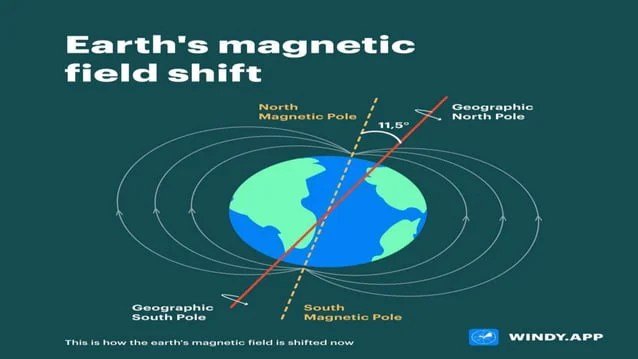
The Earth beneath our feet isn't quite as stable as it seems. Far from a static sphere, our planet is a swirling, dynamic body, constantly undergoing profound changes that shape its surface and even the invisible forces that protect us. Among the most dramatic of these phenomena are Magnetic Field Reversals and Paleomagnetism, processes that not only reshape Earth’s magnetic shield but also unlock secrets to our planet’s deep, restless past. Imagine a compass needle not just wobbling, but steadily pointing south instead of north – that’s a glimpse into the reality of a geomagnetic flip, and it has happened hundreds of times throughout Earth's history.
This guide will take you on a journey to the very heart of our planet, exploring how scientists piece together this incredible story from ancient rocks, what causes these colossal shifts, and what a future reversal might mean for life and technology on Earth.
At a Glance: Key Takeaways on Earth’s Magnetic Flips
- Earth's Magnetic Field is Dynamic: It's constantly shifting, weakening, and strengthening, not static.
- Reversals are Common: Over the last 160 million years, the magnetic poles have swapped positions hundreds of times.
- Not Always a Full Flip: Sometimes the field just weakens and drifts without a complete reversal; these are called "excursions."
- Rocks Record History: Volcanic and sedimentary rocks preserve a "snapshot" of the magnetic field's direction and intensity when they form, allowing scientists to reconstruct past magnetic activity.
- Reversals Can Be Rapid: While traditionally thought to take thousands of years, evidence suggests some reversals, including the last complete one around 770,000 to 780,000 years ago, could happen in less than a century, or even much faster in some instances.
- Caused by the Core: The magnetic field is generated by the movement of molten iron in Earth’s outer core, a process scientists call a "geodynamo." Reversals are tied to chaotic changes in this system.
- Future Impact is Debated: While a reversal wouldn't be catastrophic for life, its potential impact on modern technology (satellites, power grids) is a subject of ongoing research and discussion.
- Paleomagnetism is Key: The study of ancient magnetism in rocks (paleomagnetism) has been crucial not just for understanding reversals, but also for proving plate tectonics.
Earth's Invisible Shield: A Restless Giant
Before we dive into reversals, let's appreciate the silent guardian that is Earth's magnetic field. This invisible force field stretches thousands of kilometers into space, shielding our planet from harmful solar radiation and charged particles. Without it, our atmosphere might have long since been stripped away, rendering Earth inhospitable.
This magnetic field isn’t static; it’s a living, breathing entity, perpetually in motion. As Robert Coe, an emeritus professor of geophysics at UC Santa Cruz and a pioneer in the study of magnetic field reversals, aptly puts it, "The Earth's magnetic field is restless." Its strength fluctuates, its orientation subtly drifts, and occasionally, it performs a complete somersault, flipping its polarity entirely.
When North Becomes South: Understanding Magnetic Field Reversals
So, what exactly happens during a magnetic field reversal? In essence, the magnetic north pole becomes the magnetic south pole, and vice versa. Your compass, which today points roughly towards the geographic North Pole, would instead point south. It's a dramatic swap, but one that has occurred numerous times throughout Earth's vast geological timeline.
Records suggest that over the last 160 million years alone, the magnetic pole has reversed its polarity at least several hundred times. These events are not regular or predictable; they are, as the USGS notes, "random with no apparent periodicity to their occurrence." Some periods see frequent reversals, perhaps every 10,000 years, while others remain stable for 50 million years or more.
Adding another layer of complexity, not all shifts are full reversals. Sometimes, the Earth's magnetic field weakens significantly and begins to drift, but ultimately re-strengthens and returns to its original polarity. These are known as "excursions." They offer a glimpse into the chaotic nature of the geodynamo, showing how close the field can come to a full flip without completing the process.
The Speed of Change: Not Always a Slow Dance
For a long time, scientists believed that magnetic reversals were drawn-out affairs, taking thousands of years to complete. This gradual transition offered comfort, suggesting plenty of time for life and systems to adapt. However, recent research, spearheaded by experts like Coe, has painted a much more startling picture.
Evidence from places like Steens Mountain in southeastern Oregon, a site rich in Miocene-age basaltic lava flows, reveals a truly rapid reversal event some 15.5 million years ago. Here, the magnetic field shifted direction at an astonishing pace – between 3 and 8 degrees per day! More recently, it's been discovered that the last complete reversal, which occurred approximately 770,000 to 780,000 years ago, likely happened over a span of less than 100 years. Some studies even hint at segments of reversals occurring within a single year. This incredibly rapid "flip" challenges our understanding and raises new questions about the dynamics of Earth's core.
Unearthing Earth's Magnetic History: The Power of Paleomagnetism
How do we know any of this? We can’t simply observe events that happened millions of years ago. The answer lies in a fascinating scientific discipline called paleomagnetism, which is the study of the Earth’s ancient magnetic field as recorded in rocks.
The story of paleomagnetism truly began to unfold in the early 20th century. Geologists noticed that certain rocks exhibited a magnetic orientation different from the Earth’s present-day field. Initially, this was a curiosity, but its significance eventually dawned on the scientific community. By the 1960s, a series of influential papers, many authored or co-authored by Coe, began to identify clear polarity transitions in both lava flows and sediments, providing undeniable evidence of geomagnetic field reversals.
How Rocks Become Time Capsules
The process by which rocks record the Earth’s magnetic field is surprisingly elegant. Coe explains that as igneous rocks, such as lava, cool from their molten state, magnetic minerals within them align themselves with the prevailing magnetic field, much like tiny compass needles. Once the rock solidifies, this magnetic orientation is "locked in," preserving a snapshot of the Earth's magnetic field at that precise moment. Studying many different rocks formed at various geological periods allows researchers to create a detailed timeline of Earth's magnetic wanderings.
Volcanic rocks are excellent for these "snapshots." The layered basalt flows of Steens Mountain, for example, have provided one of the most detailed records of Earth’s rapid magnetic history, showcasing thousands of years of geomagnetic activity. However, volcanic records have a limitation: they are "discontinuous and episodic," meaning eruptions don't happen constantly, leaving gaps in the record.
To get a more complete picture, scientists also turn to sedimentary rocks. While their magnetization process is more complex and less understood than that of volcanic rocks, they offer the potential for continuous records. Highly detailed deep-sea cores, obtained through drilling operations in places like the North Atlantic, are providing exciting new data. These cores represent continuous sequences of magnetized strata, offering hope for an unbroken chronicle of Earth’s magnetic past. As Coe optimistically shared, "The North Atlantic records give one hope."
The Engine Below: What Drives Earth's Magnetic Dynamo and Reversals?
The fundamental question remains: what causes Earth's magnetic field, and why does it reverse? The prevailing explanation points to a complex process within our planet's fiery heart.
The Earth's magnetic field originates in its outer core, a vast ocean of molten iron and nickel churning some 2,900 kilometers (1,800 miles) beneath the surface. Here, intense heat from the solid inner core drives powerful convective currents. As this electrically conductive fluid moves, it generates electric currents, which in turn produce magnetic fields. This self-sustaining feedback loop is known as the "geodynamo."
The motion of these metallic fluids in the outer core creates a "dynamo-like action" that is ultimately responsible for our planet’s magnetic field. To dive deeper into this fascinating mechanism, you can explore Understanding magnetic field generation.
While the basic mechanism is understood, the exact reasons for magnetic reversals are still a subject of intense debate among geophysicists. Coe notes that "a magnetic reversal certainly has a large random or chaotic aspect," and that it's "active over many time scales." The movement of the molten metal in the outer core is inherently turbulent and unpredictable. Small changes in these convective flows can lead to large-scale disruptions in the magnetic field. When the forces generating the field become sufficiently chaotic, the main dipole field (the north-south axis) can weaken, become unstable, and eventually flip. It's like a complex, churning engine occasionally sputtering and reversing its spin before settling into a new stable state.
Living Through a Flip: The Potential Impacts of a Magnetic Reversal
If Earth’s magnetic field were to flip or even undergo a prolonged excursion, what would happen? This is a question that sparks both scientific inquiry and public concern.
During a reversal or excursion, the Earth's magnetic field significantly weakens. This weakening means less protection from solar radiation and cosmic rays. On the surface, this would primarily manifest as an increase in radiation exposure, particularly at higher latitudes and altitudes. While our atmosphere still offers significant protection, satellites, astronauts, and high-flying aircraft would be more vulnerable.
The question of whether a reversal could cause major hazards, especially to technology, is controversial and remains unanswered. Some scientists have argued that a significant weakening or reversal of the field could lead to the failure of worldwide electronic and communication systems. Imagine:
- Satellite disruption: Satellites that power GPS, communication networks, and weather forecasting could be damaged by increased radiation.
- Power grid outages: Geomagnetic storms, which are typically deflected by our magnetic field, could induce currents in long power lines, potentially causing widespread blackouts.
- Increased radiation exposure: While not immediately catastrophic for life on the ground, a sustained period of a weakened field could lead to higher rates of certain cancers over generations, and certainly pose a risk to space exploration.
However, it's crucial to remember that life has endured hundreds of magnetic reversals in Earth's history, often without any obvious mass extinctions tied directly to these events. Evolution has equipped species with resilience. The primary concerns today are not about the survival of life itself, but about the fragility of our modern, technologically dependent society. Scientists are working diligently to understand the timelines, intensities, and potential mitigation strategies for such events.
Beyond Reversals: Paleomagnetism's Broader Insights
The study of magnetic field reversals is not just a fascinating pursuit in its own right; it has also been instrumental in shaping our understanding of other fundamental Earth processes.
Perhaps the most significant contribution of paleomagnetism, as highlighted by the USGS, is its role in the evolution of the plate tectonics theory. In the 1960s, scientists observed patterns of magnetic reversals recorded in the oceanic crust, arranged symmetrically on either side of mid-ocean ridges. This "magnetic striping" provided compelling evidence for seafloor spreading – the process where new crust is generated at mid-ocean ridges and moves away in opposite directions. This observation, combined with other geological and geophysical data, provided the linchpin for the widespread acceptance of plate tectonics, explaining how continents drift and how earthquakes and volcanoes occur.
Paleomagnetism also helps scientists:
- Date rocks and geological events: By matching magnetic patterns in rocks to known reversal timelines, researchers can accurately date rock formations and the events that created them.
- Reconstruct ancient geography: The magnetic signature in rocks can indicate the latitude at which they formed, allowing scientists to reconstruct the ancient positions of continents and oceans.
- Understand climate history: Changes in the magnetic field can sometimes be correlated with climatic shifts, offering another piece of the puzzle in Earth's complex climate history.
The Unanswered Questions: What Scientists Are Still Learning
Despite decades of groundbreaking research and the insights gleaned from pioneers like Robert Coe, much about magnetic field reversals remains a mystery. Scientists continue to grapple with fundamental questions:
- The precise trigger for a reversal: While the general connection to the outer core's dynamics is clear, the exact conditions or events that initiate a full flip versus an excursion are not fully understood.
- Predicting the next reversal: Given the chaotic and non-periodic nature of reversals, predicting when the next one will occur with any certainty is currently impossible. While the field has been weakening in recent decades, it's not a definitive sign of an imminent flip.
- The full range of reversal speeds: While we have evidence of very rapid events, determining if this is the norm or an anomaly requires more continuous and detailed paleomagnetic records.
- The complete impact on living organisms: While major extinctions aren't linked, subtle long-term effects on animal migration (many species use Earth's magnetic field for navigation) or subtle evolutionary pressures are still being investigated.
The acquisition of excellent, continuous records from both volcanic and sedimentary contexts, like the deep-sea cores from the North Atlantic, is crucial for advancing our understanding.
Navigating Earth's Ever-Changing Magnetic Landscape
The story of Magnetic Field Reversals and Paleomagnetism is a powerful reminder of Earth's dynamic nature. It shows us a planet that is anything but static, constantly churning, shifting, and reshaping itself over immense timescales. From the intricate dance of molten iron deep within our core to the faint magnetic whispers preserved in ancient rocks, every discovery builds on the last, pushing the boundaries of our knowledge.
As scientists continue to monitor our restless magnetic field and unearth more secrets from Earth's past, we gain not only a deeper appreciation for our planet's history but also crucial insights into the forces that will continue to shape its future, and potentially, our own. While a future magnetic reversal is an inevitability, humanity's growing scientific understanding and technological capabilities will undoubtedly play a key role in how we navigate this ever-changing magnetic landscape.