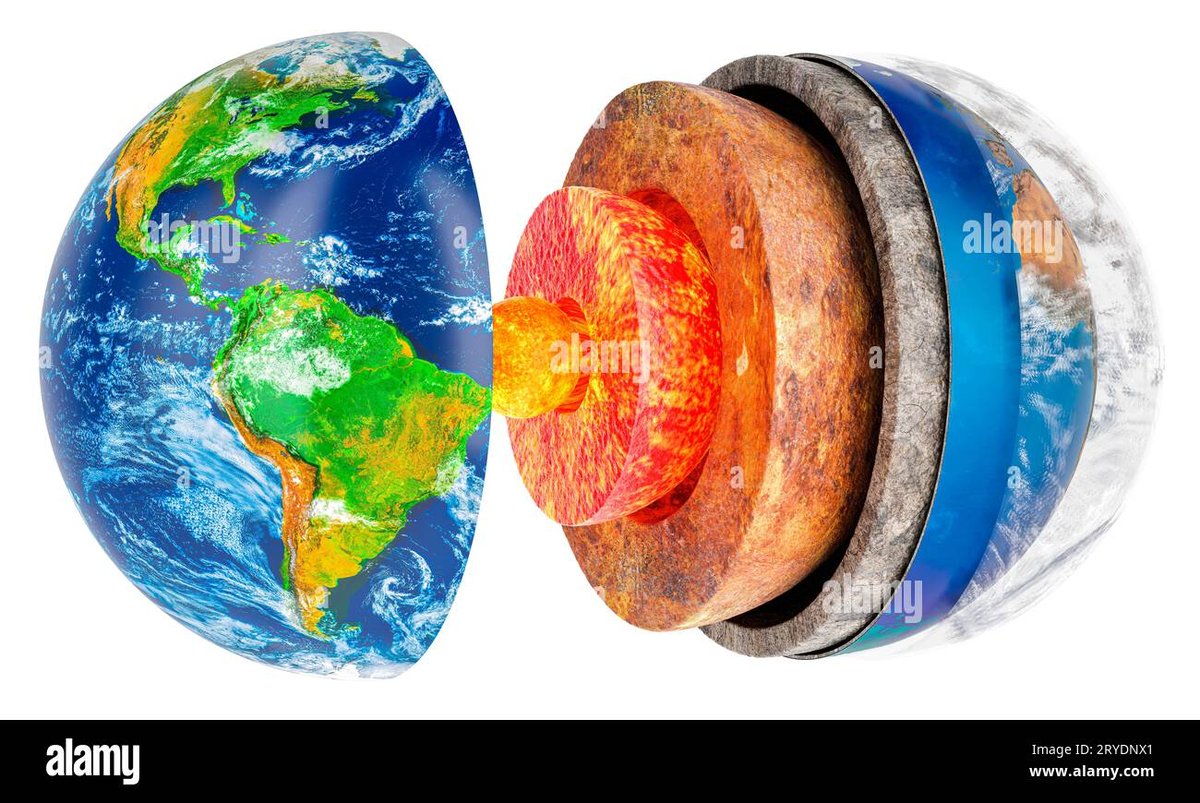
Imagine trying to understand the inner workings of a complex machine without ever being able to look inside. That's essentially the challenge scientists face when studying "Earth's Internal Layers: A Journey to the Core." For millennia, the planet beneath our feet was a complete mystery. Today, thanks to ingenious detective work using seismic waves and other indirect evidence, we've pieced together an astonishing picture of a dynamic, layered world that constantly shapes our surface, fuels volcanoes, and even generates the protective magnetic field that makes life possible.
Far from being a static ball of rock, Earth's interior is a vibrant, churning engine, each layer playing a crucial role in the planet's grand geological drama. Understanding this subterranean world isn't just academic; it’s fundamental to deciphering earthquakes, predicting eruptions, and even locating the natural resources that sustain our modern lives.
At a Glance: Diving Deep into Our Planet
- The Earth is layered: Our planet isn't uniform; it's structured like an onion, with distinct layers.
- We can't see it directly: The deepest human-made hole barely scratches the surface. Scientists use seismic waves (earthquake energy) to "scan" the interior.
- Three main layers: These are the crust (our home), the mantle (the thick, flowing middle), and the core (the dense, superheated heart).
- Each layer has unique properties: From the brittle crust to the liquid outer core and solid inner core, differences in composition, temperature, and pressure dictate their behavior.
- It's all connected: Movement in one layer, like the mantle, drives activity on another, like the shifting tectonic plates of the crust.
- The core is vital for life: Its churning liquid iron generates Earth's magnetic field, shielding us from harmful solar radiation.
Unpacking Earth’s Internal Architecture: From Surface to Center
Our planet's internal structure is typically described in three primary layers, each with its own characteristics and subdivisions. Let's embark on a descent, starting from where we stand.
The Thin Skin: Earth’s Crust
The crust is where we live, breathe, and build. It's the thinnest, outermost solid layer of Earth, remarkably fragile and brittle compared to the layers beneath it. Think of it like the skin of an apple – disproportionately thin relative to the fruit's total volume.
Two Flavors of Crust: Continental vs. Oceanic
Despite its overall thinness, the crust isn't uniform. It comes in two distinct types, each with its own story and composition:
- Continental Crust: This is the landmasses we inhabit. It's remarkably thick, ranging from 30 to a staggering 70 kilometers, especially beneath mountain ranges. Continental crust is less dense, floating higher on the mantle. It’s primarily made of lighter, granitic rocks, rich in silicon (Si) and aluminum (Al) – which geologists sometimes abbreviate as "sial." This type of crust is incredibly ancient, with some parts dating back over 4 billion years, bearing the scars of countless geological eras.
- Oceanic Crust: Found beneath the oceans, this crust is much thinner, typically only 5 to 10 kilometers deep. What it lacks in thickness, it makes up for in density. Composed mainly of basaltic rocks rich in iron (Fe) and magnesium (Mg) – "sima" – it's continuously formed at mid-ocean ridges and later destroyed at subduction zones where it plunges back into the mantle. Because of this constant recycling, oceanic crust is relatively young, rarely exceeding 200 million years in age.
What's the Crust Made Of?
Beyond its two types, the crust is a mosaic of igneous, metamorphic, and sedimentary rocks. The most abundant elements found here include oxygen, silicon, aluminum, iron, calcium, sodium, potassium, and magnesium. This diverse composition allows for a vast array of minerals and the formation of all our natural resources.
A Fractured Surface: Tectonic Plates
Perhaps the most defining feature of the crust is its fragmented nature. It's not a single, continuous shell, but rather a jigsaw puzzle of massive pieces called tectonic plates. These plates aren't static; they "float" and slowly drift on the semi-fluid layer beneath them – the asthenosphere. This constant, grinding movement is the primary driver behind most of Earth's dramatic surface events:
- Earthquakes: Occur when plates grind past each other or collide, releasing built-up stress.
- Volcanic Activity: Often found at plate boundaries where magma rises to the surface, or where one plate dives beneath another.
- Mountain Building: Massive mountain ranges, like the Himalayas, are formed when continental plates collide and crumple.
The Moho: A Distinctive Divide
The boundary between the crust and the denser mantle below isn't guesswork. It's a precisely defined feature known as the Mohorovičić Discontinuity, or simply the Moho. Discovered in 1909 by Croatian seismologist Andrija Mohorovičić, this discontinuity is marked by a sudden increase in the velocity of seismic waves, signaling a significant change in rock density and composition. The Moho tells us exactly where the crust ends and the mantle begins, typically ranging from 5-10 km under oceans to 30-70 km under continents.
Why the Crust Matters So Much
The crust is more than just our planetary skin; it's absolutely vital. It's the foundation for all geological activity we observe, supports every ecosystem, and provides essential natural resources, from minerals to fossil fuels. Without the dynamic processes occurring within and upon the crust, life as we know it would be impossible.
The Dynamic Engine: Earth’s Mantle
Beneath the thin crust lies the mantle, a colossal layer that truly acts as Earth's engine room. Extending from the Moho at about 35 km deep down to roughly 2,900 km, the mantle accounts for a staggering 84% of Earth’s total volume, making it by far the planet's thickest layer.
While often described as "solid," the mantle behaves in a peculiar way: it's solid over short timescales (like during an earthquake), but over geological eons, it acts like a thick, highly viscous fluid, flowing very slowly. Imagine tar that’s so cold and stiff it seems solid, but given enough time, it will ooze.
Layers Within the Mantle
The mantle itself isn't homogenous; it has distinct sections with varying properties:
- The Lithosphere: This is Earth's rigid outermost shell, encompassing the entire crust and the uppermost, rigid part of the mantle. Ranging from about 100 to 200 km thick, the lithosphere is strong, brittle, and prone to fracturing – it's these broken pieces that form Earth’s tectonic plates.
- The Asthenosphere: Directly beneath the lithosphere, from about 100 km to 350 km deep, is the asthenosphere. This is a crucial zone – a hot, weak, ductile, and partially molten layer within the upper mantle. Its semi-fluid consistency allows the rigid lithospheric plates to "float" and move on top of it. It effectively acts as a "conveyor belt," facilitating the slow, majestic dance of plate tectonics across the globe.
- Upper Mantle: This broader region includes both the lithosphere and the asthenosphere, extending down to about 660 km.
- Lower Mantle: From 660 km down to the core at ~2,900 km, the lower mantle is denser and more rigid dueating to immense pressure and high temperatures. However, even here, material still flows, albeit over extremely long timescales, playing a role in the deep mantle convection.
What Powers the Mantle? Composition and Temperature
The mantle is predominantly composed of silicate minerals rich in magnesium and iron, such as olivine, pyroxenes, and garnet. As pressure and temperature increase with depth, these minerals transform into denser, high-pressure forms, like perovskite, which dominates the lower mantle.
Temperatures within the mantle are extreme, ranging from approximately 500°C at its top, just beneath the crust, to over 4,000°C as it approaches the searing heat of the core.
Mantle Convection: Earth’s Grand Cycle
The defining process within the mantle is mantle convection. This is the slow, churning movement of material driven by the tremendous heat originating from Earth's interior (both residual heat from formation and radioactive decay). Hot, less dense material rises towards the surface, cools, becomes denser, and then sinks back down, creating a continuous current.
This slow-motion "boiling" of the mantle is the ultimate driving force behind nearly all of Earth’s major geological phenomena:
- Plate Tectonics: Mantle convection pushes and pulls the lithospheric plates, leading to continental drift, the opening and closing of ocean basins, and the formation of colossal mountain ranges.
- Volcanic Eruptions: Rising plumes of hot mantle material can melt and breach the crust, creating volcanoes.
- Earthquakes: The stresses generated by plate movement, driven by mantle convection, are the root cause of earthquakes.
- Mantle Plumes and Hotspots: Sometimes, particularly hot, narrow columns of mantle material, called mantle plumes, rise independently of plate boundaries. These create volcanic "hotspots" like the Hawaiian Islands, which remain volcanically active even as the Pacific plate slowly moves over the stationary plume.
The Fiery Heart: Earth’s Core
At the very center of our planet, from about 2,900 km deep to the Earth's center at ~6,371 km, lies the enigmatic core. This innermost layer, despite being inaccessible, is absolutely critical for understanding Earth's internal dynamics, its heat budget, and most profoundly, for the generation of our planet’s life-sustaining magnetic field.
Two Distinct Cores: Outer and Inner
The core isn't a single, uniform entity but is divided into two dramatically different sections:
- The Outer Core: This is a liquid layer, approximately 2,200 km thick, made primarily of molten iron and nickel. It's a turbulent, convecting fluid, and its swirling motion is the powerhouse behind Earth’s geomagnetic field through a process called the geodynamo effect. The average magnetic field strength here is estimated to be around 2.5 milliteslas, which is an astonishing 40 times stronger than what we measure at the Earth's surface. This incredible process, which gives rise to our planet's magnetic shield, is deeply fascinating. For a deeper dive into how this happens, explore the Origin of the magnetic field.
- The Inner Core: At the very heart of the Earth, nestled within the liquid outer core, is the inner core – a solid sphere with a radius of about 1,220-1,230 km. Despite extreme temperatures ranging from 5,430°C to 5,700°C (comparable to the surface of the Sun!), it remains solid. This incredible feat is due to the immense pressure at this depth, reaching 330-360 gigapascals, which compacts the iron atoms so tightly that they cannot melt.
What is the Core Made Of?
The core's primary composition is an iron-nickel alloy. However, its density is slightly lower than pure iron and nickel at the given temperatures and pressures, suggesting the presence of lighter elements. Scientists believe these include smaller amounts of sulfur, oxygen, and possibly silicon, which are largely excluded from the inner core as iron crystallizes. For instance, the outer core is thought to contain 8–13% oxygen, which is mostly left behind as iron forms the solid inner core. The inner core itself is believed to consist of ε-iron, characterized by a hexagonal close-packed (HCP) crystal structure.
How Do We Know It's There? The Discovery of the Inner Core
Given that we can't directly sample the core, how do we know so much about it? The answer lies in seismology. Danish seismologist Inge Lehmann made the groundbreaking discovery of the solid inner core in 1936. She observed that seismic P-waves (compressional waves) behaved differently than expected when traveling through the Earth's center, indicating a distinct, solid boundary within the core. Her analysis showed that P-waves refracted off a solid boundary at about 5,000 km depth.
Later, in 1971, the rigidity of the inner core was further confirmed. More recently, in 2005, scientists even detected shear waves (S-waves), which can only propagate through solids, passing directly through the inner core – a definitive proof of its solid state.
Core Dynamics: A World Under Extreme Conditions
The physical properties of the core are mind-boggling:
- Volume: The inner core alone makes up about 7.6 billion cubic kilometers, approximately 0.69% of Earth's total volume.
- Shape: It's not a perfect sphere but an oblate ellipsoid, meaning it's slightly flattened at the poles, about 3 km shorter along the Earth's axis than at the equator.
- Density: The density varies smoothly from approximately 13.0 kg/L at the very center to about 12.8 kg/L at its surface, dropping to about 12.1 kg/L in the liquid outer core just above it. Its total mass is immense, roughly 10^23 kg, accounting for about 1.7% of Earth's total mass.
- Viscosity: While solid, the inner core is still thought to undergo extremely slow convection, with an estimated viscosity of around 10^18 Pa·s, indicating extreme stiffness.
Anisotropy and the Innermost Inner Core (IMIC)
Seismic studies have revealed fascinating details about the inner core's structure. P-waves, for example, travel about 0.5% to 1.5% faster in the north-south direction compared to the equatorial plane. This phenomenon, known as anisotropy, is attributed to the alignment of the ε-iron crystals within the inner core, potentially due to slow flow patterns or differential freezing rates.
Even more recently, evidence suggests the existence of an Innermost Inner Core (IMIC), a distinct region within the inner core itself, with a radius of approximately 300-750 km (or about 650 km thick). This IMIC exhibits unique anisotropic properties, hinting at a potentially different formation history or a record of past global events. A 2023 study indicated that P-wave speeds are about 4% slower at around 50° from Earth's rotation axis within this innermost region.
Growth and Rotation: A Core in Flux
The inner core is not static; it's slowly growing larger. As the liquid outer core cools, iron crystallizes onto the surface of the inner core, causing it to expand by approximately 1 millimeter per year. This crystallization process also enriches the remaining liquid outer core in lighter elements like oxygen, which, being less dense, rise and drive the vigorous convection currents that sustain Earth's magnetic field.
Furthermore, the inner core can rotate differentially from the mantle and crust. For a long time, it was believed to "super-rotate," spinning slightly faster than the rest of the planet (at about 0.3-1 degree per year). However, studies in 2023 have suggested a more complex behavior: the inner core appears to have stopped spinning faster around 2009 and is now rotating slower, possibly exhibiting an oscillation cycle of approximately seven decades. This dynamic rotation influences global geodynamics and the magnetic field.
How Old is Our Planet's Heart?
Estimating the age of the inner core is a complex scientific challenge, but current models suggest it formed relatively recently in Earth's history, somewhere between 0.5 and 2 billion years ago. These estimates are derived from thermodynamic modeling of Earth's cooling and paleomagnetic evidence, such as a prominent increase in Earth's magnetic field strength and variance roughly 1.0–1.5 billion years ago, and anomalies around 565 million years ago, which might signal the onset of inner core formation. Its formation was a pivotal event, fundamentally altering the planet's heat engine and strengthening its magnetic shield.
Reading Earth’s Pulse: Actionable Insights from Deep Within
Studying Earth’s internal layers isn't just about satisfying scientific curiosity; it provides critical insights that empower us to better understand and respond to the forces shaping our world. The knowledge gained from this "journey to the core" has profound practical applications:
- Understanding and Mitigating Earthquakes: By analyzing how seismic waves travel through the planet, scientists can map out fault zones with remarkable precision. This helps us understand where stress is building up along plate boundaries, allowing for better seismic hazard assessments, improved building codes, and potentially, long-term strategies for disaster preparedness. While precise earthquake prediction remains a challenge, understanding the underlying mechanics driven by the mantle is crucial.
- Forecasting Volcanic Eruptions: Our knowledge of the upper mantle, particularly the sources of magma and the dynamics of mantle plumes, is vital for predicting volcanic eruptions. Monitoring changes in seismic activity, ground deformation, and gas emissions, combined with an understanding of the magma plumbing system originating in the mantle, allows geologists to issue timely warnings, saving lives and property.
- Locating Natural Resources: Many of the valuable minerals, metals, and fossil fuels we rely on are formed through geological processes intimately linked to Earth’s internal heat and plate tectonics. Understanding the deep processes of rock formation, crustal deformation, and mantle upwelling helps prospectors identify promising regions for mineral exploration and hydrocarbon deposits.
- Protecting Life with the Magnetic Field: The dynamic churning of the liquid iron in the outer core generates Earth’s powerful magnetic field. This field acts as an invisible shield, deflecting harmful solar radiation and cosmic rays that would otherwise strip away our atmosphere and make the surface uninhabitable. Without this magnetic field, the evolution and sustenance of life on Earth as we know it would be impossible. Continuous monitoring and understanding of the geodynamo is crucial for predicting potential future changes to this vital shield.
- Deciphering Plate Tectonics: The movement of the lithospheric plates, driven by mantle convection, is the overarching framework that explains the distribution of continents, the formation of colossal mountain ranges, the creation of ocean basins, and the global distribution of geological hazards. This understanding allows us to reconstruct Earth's past geography, predict future continental configurations, and better comprehend the long-term evolution of our planet.
The Unseen World That Shapes Our Own
Our "journey to the core" reveals a planet far more intricate and active than meets the eye. From the thin, fractured crust where life flourishes, through the slowly churning mantle that drives our geological cycles, to the superheated, metallic core that generates our protective magnetic shield, each layer tells a vital part of Earth’s ongoing story. This deep understanding of Earth's internal layers empowers us not just to appreciate the grandeur of our home planet, but also to live more harmoniously with its powerful, dynamic forces. It's a reminder that even the ground beneath our feet holds mysteries that, once unveiled, unlock profound insights into the nature of our world.